As we move through 2026, the industrial landscape is experiencing a fundamental shift. For decades, the “Big Automation” players kept their ecosystems closed. However, the demand for data, flexibility, and edge computing has forced a transition toward Open-Source Industrial Technology.
The most significant trend this year? The mainstream adoption of Linux-based PLCs.
1. The Death of the “Black Box”
Traditionally, a PLC was a “black box”—you used the manufacturer’s software, their cables, and their protocols. Today, engineers are demanding controllers that offer more than just ladder logic.
Linux-based controllers allow for:
- Multi-Language Support: Running Python scripts alongside real-time PLC logic.
- Native IIoT Integration: Built-in support for MQTT and Sparkplug B.
- Containerization: Using Docker to run apps like Node-RED directly on the PLC hardware.
2. Convergence of IT and OT
The gap between Information Technology (IT) and Operational Technology (OT) has officially closed. In 2026, a Logic Hobbyist with skills in both Python and electrical circuitry is more valuable than a traditional technician.
Companies are looking for “Hybrid Systems” where the low-level safety is handled by a deterministic logic engine, while the high-level data processing is handled by open-source Linux tools.
3. Why This Matters for the Logic Hobbyist
This trend is an “income multiplier” for those who understand open-source tools. You no longer need to spend thousands on proprietary training. By mastering tools like [OpenPLC] and [Node-RED], you are learning the exact skills being deployed in modern “Smart Factories.”
4. Hardware to Watch in 2026
We are seeing incredible hardware hitting the market that bridges the gap:
- Industrial Raspberry Pi Alternatives: DIN-rail mounted units with 24V I/O.
- PLC-on-a-Chip: High-speed microcontrollers running real-time Linux kernels.
- Software-Defined Automation: Where the “PLC” is simply a software app running on an industrial PC.
🔥 Spotlight: Affordable Automation with akYtec
As part of the shift toward accessible industrial tech, companies like akYtec are leading the way. They offer a range of PLCs, HMIs, and digital displays that prove high-performance automation doesn’t have to be expensive.
- Zero Software Costs: Their “akYtec ALP” programming software is completely free, removing the biggest barrier for students and small-scale developers.
- Compact Design: Their programmable relays are designed for DIN-rail mounting, perfect for professional control cabinets.
- Standard Protocols: Built-in Modbus support makes them a natural fit for the open-source ecosystems we discuss here at LogicHobbyist.
Real-World Implementation: LogicHobbyist in Action
“Innovation is best understood through application. Here is a look at one of my recent automation projects utilizing akYtec PR200 programmable relay hardware to solve a specific industrial control challenge. It takes me less than one hour to get the project tested thanks to the intuitive function block environment.”
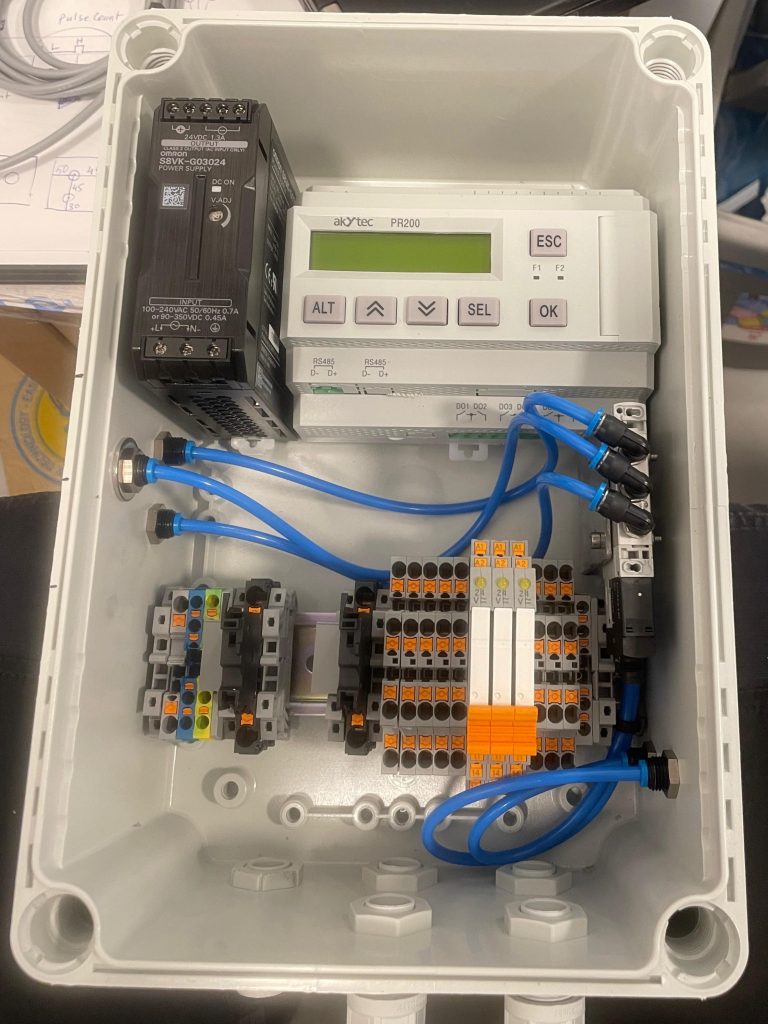
📸 Featured Hardware: PR200 akYtec Programmable Logic Device in a custom control assembly.
Project Highlights:
- The Challenge: Building a reliable, compact control logic without the high cost of proprietary licenses.
- The Solution: Leveraging akYtec’s free ALP software and robust hardware for a professional-grade finish.
- The Result: A seamless integration that bridges the gap between hobbyist prototyping and industrial reliability.