
Published by LogicHobbyist Automation Lab — A complete guide for controls engineers and electricians. Understand the difference, wiring rules, global standards, and how to avoid costly mistakes.
One of the most common points of confusion in industrial automation is the difference between sourcing and sinking digital I/O. Mix them up, and your sensors won’t work, outputs won’t activate, or worse – you can short‑circuit a PLC card. This guide explains the electrical principles, shows wiring examples, and gives you a simple rule to remember forever.
1. The Electrical Foundation
Every digital output is a switch that connects the output terminal either to +V (supply) or to 0V (common/ground). That is the only difference.
- Sourcing output (PNP): When active, the output terminal is connected to the positive supply (+24V). Current flows out of the output, through the load, to ground.
- Sinking output (NPN): When active, the output terminal is connected to ground (0V). Current flows into the output, through the load from the positive supply.

Figure 1: Sourcing (PNP) vs Sinking (NPN) wiring
2. Naming Conventions Around the World
Different regions and manufacturers use different terms for the same thing:
| Term A | Term B | Current direction (active state) |
|---|---|---|
| Sourcing | PNP | Current flows out of output |
| Sinking | NPN | Current flows into output |
| Source type | Positive logic | Active = high (+V) |
| Sink type | Negative logic | Active = low (0V) |
3. Sensors and Field Devices – Which one to choose?
Most industrial sensors (inductive, photoelectric, capacitive) are available in both PNP (sourcing) and NPN (sinking) versions.
- In Europe and most of the world, PNP (sourcing) is the de facto standard. PLC input cards are usually sourcing (they expect a +24V signal).
- In some Asian markets (Japan, etc.), NPN (sinking) is common.
- Never assume: Always check the PLC manual and the sensor datasheet.

Figure 2: Festo proximity sensor marked PNP on the electrical symbol – BN: Brown wire (Power supply +), BK: Black wire (Output+), BU: Blue wire (Power supply -).

Figure 3: Festo proximity sensor marked NPN on the electrical symbol – BN: Brown wire (Power supply +), BK: Black wire (Output-), BU: Blue wire (Power supply -).
4. Wiring examples (real components)
4.1 Sourcing (PNP) PLC output driving a DC relay
Connect PLC output → relay coil (+) → relay coil (−) → 0V. When output is ON, +24V appears at the output terminal, current flows through the coil to ground.
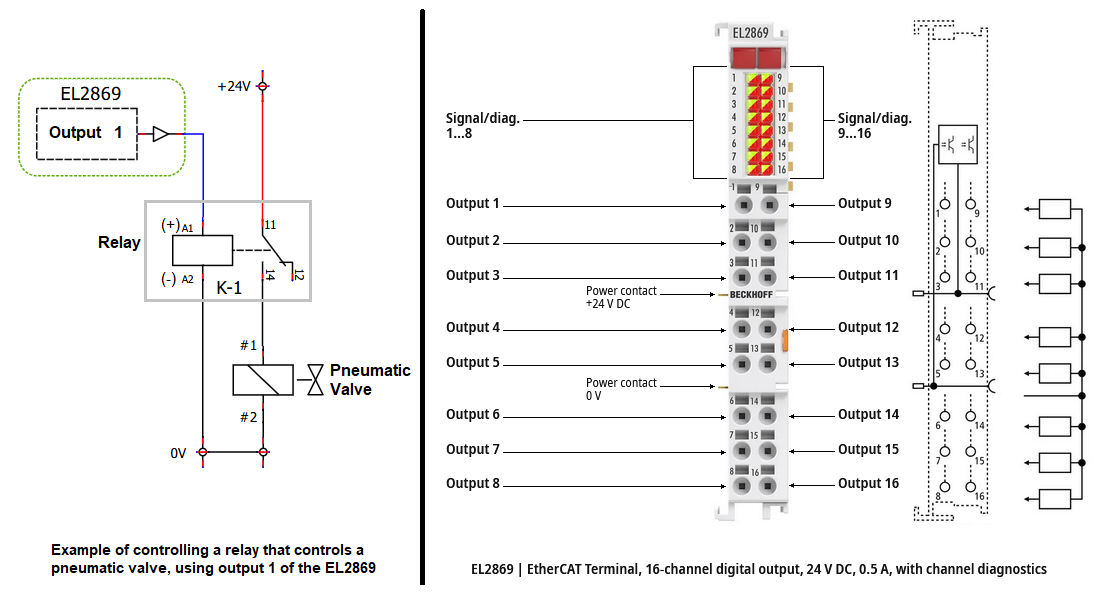
Figure 4: The Beckhoff EL2869 digital output card controls a coil that controls a pneumatic valve.
4.2 Sinking (NPN) PLC output driving the same relay
Connect +24V → relay coil (+) → relay coil (−) → PLC output. When output is ON, the output terminal is connected to ground, completing the circuit.
Bottom line: The load is always connected between the output and the opposite supply rail.
5. Detailed Feature Comparison: Sourcing vs Sinking
| Feature | Sourcing (PNP) | Sinking (NPN) |
|---|---|---|
| Active state voltage | +V (e.g., +24V) | 0V (ground) |
| Common in | Europe, Americas, most modern PLCs | Japan, older Asian equipment |
| Sensor naming | PNP (switches positive) | NPN (switches ground) |
| Short‑circuit protection | Often built‑in (per channel) | Often built‑in as well |
| Commoning point | All outputs share +V common | All outputs share 0V common |
| Typical wire colour (IEC) | Blue (0V), Brown (+24V), Black (signal) | Same colours – function differs |
6. Can you mix sourcing and sinking?
Yes, but only on different output groups or with external interposing relays. Many PLCs have multiple commons (e.g., two separate 8‑point groups). One group can be wired as sourcing, another as sinking – as long as each group’s common is connected correctly.
If you need to connect a sinking output to a sourcing input, use a small interposing relay: the sinking output energizes the relay coil, and the relay contact connects to the sourcing input.
7. Advantages & Disadvantages – Sourcing vs Sinking
- Standard in most of the world – easier to find components
- Failsafe: broken wire to sensor usually reads as “off” (0V)
- More intuitive for electricians (positive signal = on)
- Better noise immunity (active high)
- Requires a common positive rail – can complicate wiring
- Typically more expensive than NPN in some regions
- Not compatible with legacy NPN‑only systems
- Can directly drive loads that have a common positive (e.g., some LED banks)
- Preferred in certain legacy Japanese systems
- Sometimes cheaper sensors for low‑volume markets
- Broken wire can be misinterpreted as “on” (pull‑up required)
- Less intuitive for electricians (active low)
- Generally poorer noise immunity than PNP
8. Real‑World Decision Guide
✅ When to use sourcing outputs
- You are designing a new control panel (global best practice).
- Your PLC is from Siemens, Beckhoff, Allen‑Bradley (most families), Schneider, or B&R.
- You want compatibility with the majority of industrial sensors on the market.
- Your electricians are trained on “positive switching”.
Example: A new Beckhoff CX7000 with EL2008 output card – always wire sourcing (PNP) unless special requirement.
✅ When to use sinking outputs
- You are integrating an older Japanese machine (e.g., Mitsubishi FX series in NPN mode).
- Your entire plant standard is NPN (rare outside Asia).
- You need to drive a load that has a common +V (e.g., a seven‑segment display with common anode).
Example: Retrofitting a legacy Fanuc robot that expects NPN signals – use a sinking output card or interposing relays.
9. How to check your PLC output type (quick guide)
- Look at the part number: Many manufacturers encode output type: e.g., “8DO 24V DC 0.5A PNP” or “NPN”.
- Check the common terminal labeling: If the common is labelled “+V” or “24V”, it’s likely sourcing (outputs switch to +V). If the common is “0V” or “COM”, it’s sinking.
- Measure with a multimeter: In the OFF state, measure between output and 0V. If you see +24V, it’s a sinking output (output is pulled up). If you see 0V, it’s a sourcing output (output is floating or pulled down). Then turn ON the output – the voltage should change to the opposite rail.
10. Summary – final answer table
| Scenario | Recommended output type |
|---|---|
| New control panel, Europe or USA | Sourcing (PNP) |
| Retrofitting a Japanese machine (Mitsubishi, Omron NPN) | Sinking (NPN) or interposing relays |
| Connecting to a relay coil | Either works (wire accordingly) |
| Connecting to a Siemens PLC input | Sourcing (PNP) – Siemens inputs are sourcing |
| You are unsure and want maximum safety | Use interposing relays (isolates output type) |
LogicHobbyist Automation Lab – independent technical reference for
industrial controls. No sponsored content, only engineering best practices.
📘 Next reading: Digital Input Types: Dry Contact vs. Voltage Input